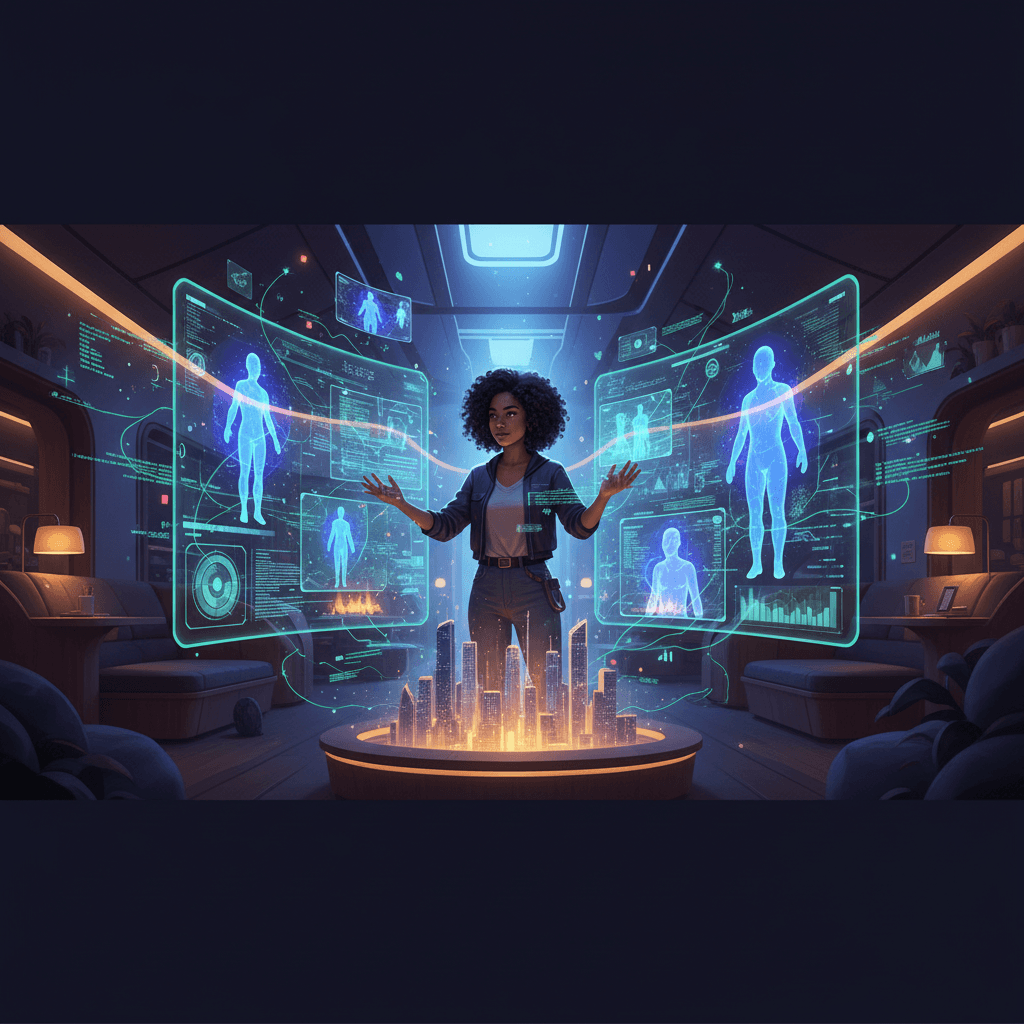
AI Isn't Replacing Teachers. It's Exposing What Schools Should Have Always Been Doing.
AI Isn't Replacing Teachers. It's Exposing What Schools Should Have Always Been Doing.
There's a particular panic that surfaces every time a new technology enters the classroom. Calculators were going to ruin mathematical thinking. Laptops were going to kill focus. The internet was going to make teachers obsolete.
And now: AI is going to end education as we know it.
Here's the problem with all of these takes — they assume that what education currently is is what it should be. That the goal of school is to transfer information, assess recall, and certify competency in a standardized way. By that definition, yes, AI disrupts education badly.
But that definition was always wrong.
What School Was Optimized For
The modern education system was designed for industrial-era efficiency. It needed to produce literate, numerically proficient workers who could follow instructions, perform standardized tasks, and behave predictably within hierarchies.
That's not a conspiracy. It was genuinely the right optimization at the time. The problem is we kept optimizing for it long after the world changed.
In 2026, information is free. Recall is not the scarce resource. Neither is basic procedural competence — AI handles that at the margin.
What's scarce is:
- Judgment under uncertainty
- Creative synthesis across domains
- The ability to ask better questions
- Emotional intelligence, persuasion, leadership
- The will to start something before you feel ready
None of these are assessed on standardized tests. Most of them atrophy in traditional classrooms.
What AI Actually Does to This Picture
AI tutors like Khan Academy's Khanmigo, or the emerging class of personalized learning agents, are genuinely excellent at the information-transfer layer. Better than most textbooks. Often better than rushed classroom instruction.
This is not bad. This is freeing.
If an AI can handle "here's the concept, here are practice problems, here's feedback," then the human in the room is free to do things AI cannot: model judgment, create real stakes, facilitate genuine collaboration, and build the kind of trust that makes hard feedback land.
The teacher's highest-value job was never explaining the quadratic formula. It was noticing the kid who stopped trying and figuring out why.
The BCI Framework
BCI Innovation Labs is built on a different theory of education: Build → Measure → Learn, borrowed from lean startup methodology and applied to human development.
We don't teach entrepreneurship as a subject. We co-found real ventures with students. The learning happens through doing — through the friction of real markets, real customers, real failure.
AI is embedded in this framework not as a threat, but as a tool. Our students use AI for research, prototyping, code generation, and content creation. We don't pretend the tools don't exist. We teach people to work with them, which means developing the meta-skills that let you direct, evaluate, and improve AI output.
Those are the same skills that will matter in any knowledge economy job over the next 30 years.
What Good Looks Like
The schools and programs that will thrive in the next decade are not the ones that ban AI. They're the ones that:
-
Redesign assessments around judgment, not recall. Ask students to evaluate AI-generated work, improve on it, and defend their choices. That's a harder cognitive task than memorizing.
-
Create real stakes. When students are working on something that matters — a real product, a real community problem, a real client — motivation problems largely disappear.
-
Let teachers teach. Reduce administrative burden, surface student data proactively, and give teachers the tool layer that lets them spend their time on relationships and mentorship.
-
Embrace failure as data. The lean loop requires iteration. Schools that treat failure as a verdict rather than a signal are optimizing for a world that doesn't exist anymore.
The Uncomfortable Truth
The reason AI in education feels so threatening is that it exposes how much of what we call "learning" was really just compliance. Sitting quietly, recalling on demand, performing for the test.
That kind of learning was always fragile. AI is just making the fragility visible.
The students who are going to thrive are the ones who were already building, making, questioning, and creating — with or without technology. AI gives them a superpower. For the students who were only performing compliance? It's a wake-up call.
At BCI Innovation Labs, we're not waiting for the education system to catch up. We're building the alternative.
BCI Innovation Labs is a startup factory for outliers, misfits, and rebels. We co-found real ventures with students and entrepreneurs using a Lean Education Framework. If this resonates, get in touch.
Mark Weyers Ed.D
Founder of BCI Innovation Labs. Ed.D researcher focused on educational innovation, AI integration, and building companies that matter.
Related Articles
Build something that matters.
BCI Innovation Labs co-founds real ventures with students and entrepreneurs. If this resonates, we want to meet you.
Get in touch →